

Tankless vs. Tank Water Heater: Which Is Right for Your Home?
6 min read • August 28th, 2026
6 min read • August 28th, 2026

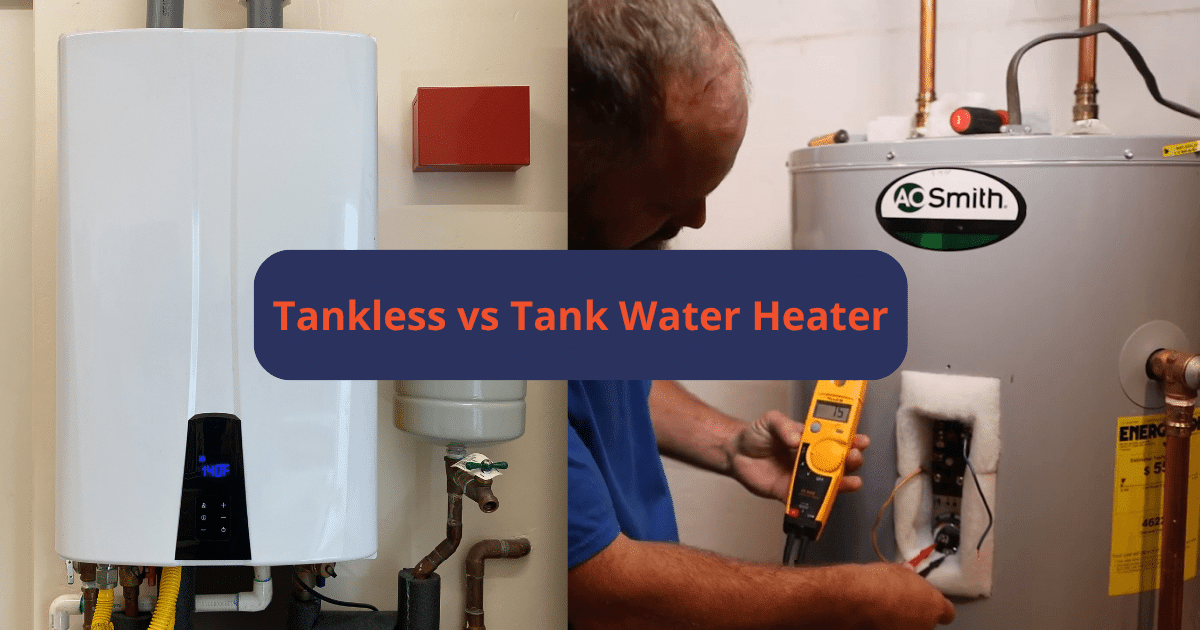
Confused about the differences between tankless vs. tank water heater? If you’re shopping for a new water heater, you’re going to need to weigh those differences pretty quickly. While both heat your water, they work very differently, have different costs, and suit very different households.
This guide breaks down everything you need to know to make the right call for your home and dispels a few myths along the way too.
Before you can weigh the pros and cons, it helps to understand how each one works.
A tank water heater is comprised of a large insulated tank, typically holding 30 to 80 gallons of water, that keeps water hot around the clock. Turn on the tap, and hot water flows immediately from that stored supply. It’s been the standard in American homes for decades because it’s simple, reliable, and it works.
A tankless water heater works completely differently. There’s no holding tank of water. Instead, cold water flows through the unit, passing over a heat exchanger which heats it instantly. It only runs when you need it, and the moment you turn off the tap, the unit shuts off.
This fundamental difference in design is directly connected to the cost differences, the efficiency differences, and the tradeoffs associated with tankless and tank water heaters.
Tankless systems have been popular in Asia and Europe for years and are increasingly common in new American homes. They are more energy efficient, take up far less space, and last significantly longer than tank systems — typically 15 to 20 years compared to 8 to 12.
The appeal is real. But so are the misconceptions, and the team at Heil Plumbing & HVAC has seen the same three come up again and again. Here are the facts from Mengning Heil.
Myth 1: Tankless water heaters give you instant hot water. Not quite. A tankless heater fires up the moment you turn on the faucet — but you’ll still wait for hot water to arrive, just like you would with a tank. That wait has nothing to do with your heater. It’s just how far the water has to travel through your pipes to reach you.
If instant hot water is the goal, a recirculation pump is what you’re actually looking for. It works with both tank and tankless systems and is worth adding to the conversation when you’re planning your install.
Myth 2: Tankless water heaters will save you money.
They’ll save you something — but probably not as much as you’ve been led to believe. A tankless unit can trim your monthly energy bill by $10 to $20. The problem is the upfront cost. Converting from a tank involves running new vent pipes, installing new water and gas lines, adding an electrical outlet, routing a condensate line, and sometimes upgrading your gas meter. It’s a full day’s work for a skilled plumber, and installation alone can run several thousand dollars on top of the unit.
The energy savings are real — they just take years to offset the investment. Whether tankless makes financial sense depends on your household, your usage, and how long you plan to stay in the home.
One note on electric tankless systems specifically: whole-house electric tankless units are rarely the right choice for most American homes. The electrical demand is significant, and the cost of upgrading your panel and wiring to support it usually makes the economics unfavorable. Electric tankless is more commonly used for point-of-use applications — a single faucet or shower — not whole-house systems. If you’re considering it, talk to both your plumber and your electrician before committing.
Myth 3: Tankless water heaters provide unlimited hot water.
Technically, no. A tankless unit heats water continuously, but every unit has a maximum flow rate measured in gallons per minute. Push past that limit by running the shower, dishwasher, and a hot laundry cycle at the same time, and the unit won’t be able to keep up.
This can be managed by proper sizing. An experienced plumber can calculate your household’s peak demand and recommend a unit with the right output. Get that right from the start, and you will feel like you have unlimited hot water.
The takeaway: tankless can be a genuinely strong option for the right home — as long as you know what you’re actually getting.
There’s a reason tank water heaters have been the go-to in American homes for generations. They work, they’re affordable, and they’re not complicated.
If your home is like most and already has a tank water heater, replacing one is one of the simpler major appliance jobs a plumber does. The upfront cost is lower than tankless, installation is faster, and hot water is available immediately from the stored supply. For families with predictable routines, the system works nicely.
Where a tank falls short is energy efficiency. It keeps water hot all the time, whether you need it or not. That continuous energy use is the main reason tank systems cost more to operate month-to-month than tankless ones. The other limitation is capacity: when the tank runs dry after heavy use, you’re waiting 20 to 30 minutes for it to recover.
Expect a tank water heater to last 8 to 12 years. Keep up with periodic flushing to reduce sediment buildup and occasional anode rod replacement, and you’ll get the most out of that lifespan.
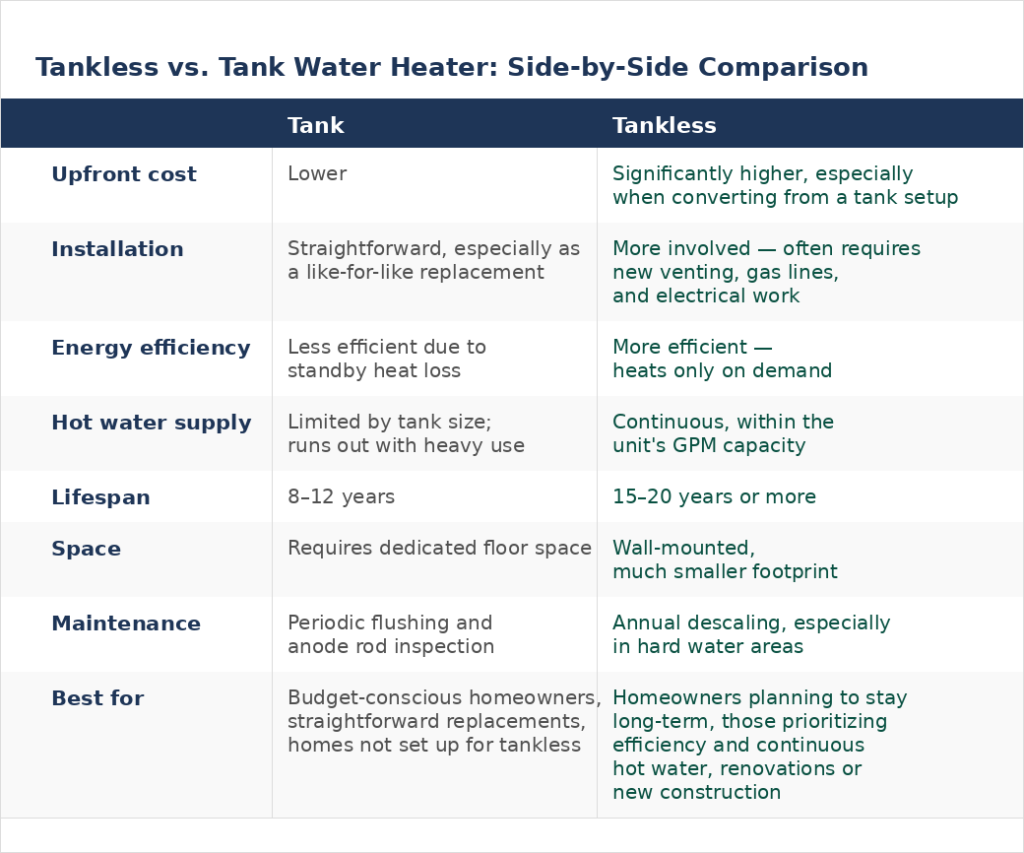
The answer depends less on which system is objectively better and more on your situation.
Dealing with a dead water heater and need a solution today? A tank water heater is almost always the right call — lower upfront cost, faster installation, and reliable performance for a decade or more.
Planning a renovation, building new, or thinking long-term about your home? Consider a tankless water heater. The efficiency gains and longer lifespan make a compelling case — as long as you understand what the installation involves and budget accordingly.
One thing that applies in either case: if your household has high simultaneous hot water demand, sizing matters enormously. An undersized tankless water heater is one of the most common mistakes homeowners make — and one of the easiest to avoid with the right plumber guiding the decision.
A good place to start is knowing how old your current unit actually is. Most homeowners don’t know their water heater’s age off the top of their head — but it’s easier to find than you’d think. Read our guide on how to find out how old your water heater is to decode the serial number and figure out where you stand. Then decide if water heater repair or replacement is right for you.
AO Smith, State, and Bradford White all manufacture quality tank and tankless units and are trusted by professional plumbers for the same reasons: build quality, parts availability, and reliable manufacturer support. For a full breakdown of why we recommend these three over the competition, read our guide on the best water heater brands according to plumbers.
The upfront cost and installation complexity. Converting from a tank to a tankless system often requires new venting, gas line work, and electrical upgrades — which adds significantly to the total cost beyond the unit itself.
Not in the traditional sense — but it can be exceeded. Every tankless unit has a maximum flow rate measured in gallons per minute. If your household’s simultaneous demand exceeds that rate, the unit won’t be able to keep up. Proper sizing prevents this.
Yes — and it’s more precise than a tank. Most tankless units have a digital controller that lets you set the exact output temperature, typically anywhere from 100°F to 140°F. The U.S. Department of Energy recommends 120°F for most households — hot enough for daily use and appliances, low enough to prevent scalding and reduce mineral buildup. For more on finding the right temperature setting, read our guide on how to turn up your water heater.
It can be — but it depends on your situation. If you’re planning to stay in your home for many years, want to reduce your energy bill over time, and are prepared for a higher upfront installation cost, switching to tankless makes a lot of sense. If you need a quick, affordable replacement or your home isn’t already set up for tankless, sticking with a tank is often the smarter call. The energy savings are real but modest — roughly $10 to $20 a month — so the math works better the longer you stay in the home. A licensed plumber can assess your setup and give you an honest answer on whether the switch makes financial sense for your specific situation.
If you’re in the Maryland or DC area, there are a few local factors worth considering before you decide on a water heater: hard water is common across much of the region, and older homes in Baltimore City and Howard County are more likely to need additional prep work for a tankless conversion. These are exactly the kinds of details our licensed plumbers factor into every recommendation.
If you’re looking for water heater replacement in Howard County, Heil Plumbing & HVAC serves Howard County, Baltimore County, Anne Arundel County, Montgomery County, and beyond, and we’ll give you an honest answer based on your home, your budget, and your hot water needs. Contact us to get started. We’d love to help.