

Being a Plumber: What the Career Actually Looks Like
6 min read • October 26th, 2026
6 min read • October 26th, 2026


Being a plumber doesn’t get the credit it deserves. It’s one of the most stable, well-compensated, and genuinely rewarding careers available — and it doesn’t require a four-year degree or end with a mountain of student debt. If you’re curious what the trade actually looks like day-to-day, here’s an honest look from a family that has been living it for three generations.
First, let’s talk about why plumbing is a good career path.
According to the U.S. Bureau of Labor Statistics, the median annual wage for plumbers, pipefitters, and steamfitters is over $63,800, with experienced master plumbers earning significantly more. Job growth in the trades is projected to outpace many white-collar fields over the next decade. That growth comes as a result of aging infrastructure, new construction, and a shortage of skilled tradespeople entering the workforce.
But the financial case is only part of the story. Plumbing is a career that involves solving real problems every day and making a tangible difference in someone’s home or business. At the end of the day, there’s no guessing about whether your work mattered. If a plumbing problem was solved, it mattered!
Joseph Heil understood those benefits when he became a plumber 70 years ago.
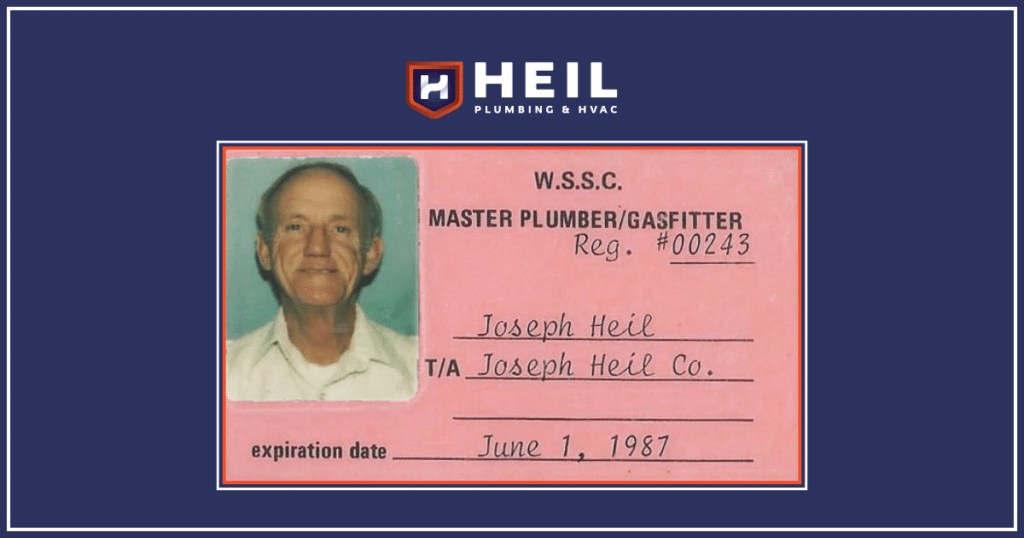
In 1956, Joseph Heil began his career as a residential plumber. He spent two decades learning the trade before he and his wife Miriam launched the Joseph Heil Company out of their home in 1977. What started as a small family operation grew steadily as Joseph’s reputation for quality work and honest service grew.
In 1990, Joseph’s son Edward joined the company full time, ushering the second generation of Heils into the trade. By 1996, the business had grown enough that Edward’s wife Laurie took over administration, building the operational foundation that would support the company’s continued growth.
Then in 2001, Edward and Laurie’s children, Eddie and Charlie, joined the team, becoming the third generation of Heils to choose plumbing as a career. In 2020, Eddie and his wife Mengning expanded the family business by opening Heil Plumbing & HVAC DMV to serve the Montgomery County area. Three years later, the two operations merged, with Charlie, Eddie, and Mengning taking the reins of a company that now serves thousands of residential, commercial, and government clients across the greater Baltimore and Montgomery County areas.
That kind of continuity happens because the work is meaningful, the career is sustainable, and the values that built the company in 1977 are worth preserving.
One of the biggest misconceptions about being a plumber is that every day looks the same. It doesn’t. The variety of work is one of the things experienced plumbers consistently cite as a reason they stay in the trade.
On any given day, a Heil plumber might be diagnosing a water leak in a residential home in the morning, inspecting a sewer line with a camera system in the afternoon, and troubleshooting a water heater issue before the end of the day. The problems are different, the homes are different, and the solutions require genuine critical thinking, not just a set of memorized steps.
While the work is physical, it’s also deeply technical. Modern plumbing involves understanding water pressure, pipe materials, building codes, drainage systems, and gas lines. New technologies, like trenchless pipe repair and advanced diagnostic equipment, mean that there’s always more to learn.
Plumbing is a skilled trade in every sense of the word, and the necessary skills require diligent training.

The path into plumbing doesn’t require a college degree, but it does require commitment, physical stamina, and a genuine aptitude for problem-solving. Most plumbers need a high school diploma or GED, a valid driver’s license, solid applied math skills, and the kind of systematic thinking that leads to good problem-solving. It’s important for a plumber to have strong communication skills as well so they can explain a complex job to a customer and train others on the team.
The career path itself is one of plumbing’s most appealing qualities. Unlike many professions where the path to advancement is unclear, the plumber career path follows a clear progression:
The path from apprentice to master plumber has looked roughly the same for decades — but the trade those plumbers step into has changed considerably.
Though the fundamentals remain the same, plumbing in 2026 looks very different from the trade Joseph Heil entered in 1956.
First, the materials have changed significantly. Galvanized steel and lead pipes, once standard in residential construction, have been largely replaced by safer and more durable copper, PVC, and PEX. A plumber starting out today needs to understand a much wider range of pipe materials and when each is appropriate.
Second, the technology has transformed what’s possible on a service call. Sewer camera inspections let plumbers see exactly what’s happening inside a pipe without digging. Trenchless pipe repair allows damaged lines to be rehabilitated with minimal disruption to a property. Digital diagnostic tools give technicians data that would have been impossible to gather a generation ago.
In addition to that, codes and regulations have become more complex. Water efficiency standards, building codes, and environmental regulations require plumbers to stay current with evolving requirements, making continuing education a real and ongoing part of the job.
Finally, the scope of the trade itself has expanded. Many plumbing companies, including Heil, now offer HVAC services alongside traditional plumbing, reflecting the growing overlap between the systems that keep a home comfortable and the expertise required to service them.
What hasn’t changed is the core of the work: water needs to flow in, waste needs to flow out, and when something goes wrong, someone with the right skills needs to fix it. That need isn’t going anywhere and neither is the demand for the people who can meet it.
Yes. The demand for skilled plumbers is projected to grow steadily over the next decade. Plus, plumbing is also largely resistant to automation — the diagnostic, hands-on nature of the work is difficult to replicate with technology.
Most plumbers complete a four- to five-year apprenticeship before becoming licensed journeymen. Becoming a master plumber typically requires several additional years of experience and a licensing exam. The full path from apprentice to master plumber usually takes eight to ten years, but plumbers earn a wage throughout the entire process.
The median annual wage for plumbers in the U.S. is over $63,000, with experienced master plumbers earning significantly more. Plumbers who own their own businesses have essentially unlimited earning potential.
No. Plumbers typically enter the trade through an apprenticeship program rather than a college degree. This means most plumbers enter the workforce with no student debt and years of paid on-the-job experience.
A journeyman plumber is licensed to work independently on most plumbing projects. A master plumber has additional licensure that allows them to pull permits, design plumbing systems, supervise other plumbers, and operate their own plumbing business.
Yes — the work involves lifting, kneeling, working in tight spaces, and spending time on your feet. That said, many experienced plumbers find that the physical demands become more manageable with time, and the trade offers enough variety that no two days feel exactly the same.
The Heil family has spent nearly 70 years building a legacy of quality home service. If you’re considering plumbing as a career and you’re looking for a team that takes craftsmanship seriously, treats customers honestly, and invests in the people who work for them, we’d love to talk.
Our Baltimore County, Montgomery County, Carroll County, Anne Arundel County, Prince George’s County, and Howard County plumbers hold themselves to a high standard. If that sounds like a team you want to be a part of, visit our Careers page to learn more.