

Boiler vs. Furnace: Which Heating System Is Right for Your Home?
5 min read • September 30th, 2026
5 min read • September 30th, 2026

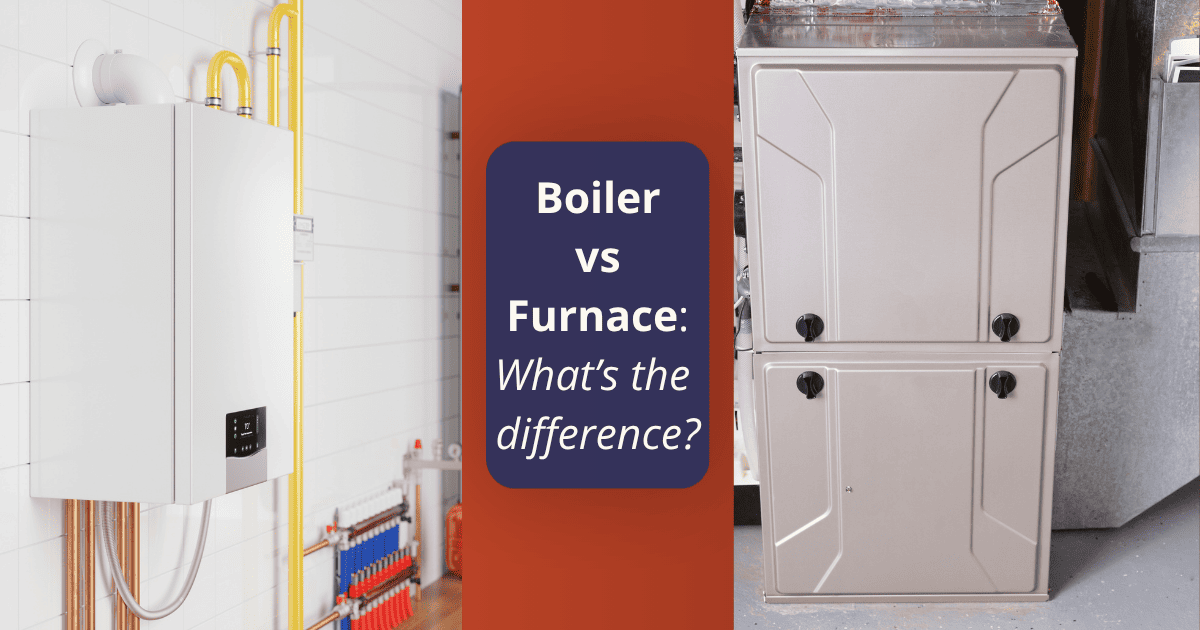
If you’re replacing a heating system or building new, you’re going to run into the boiler vs. furnace question pretty quickly. Both systems heat your home effectively, and both have been doing it reliably for decades. But they work very differently, suit very different homes, and come with different costs and maintenance needs.
This guide breaks down everything you need to know to make the right call — including the one factor that makes the decision easier than most people expect.
Before you can decide between a boiler and a furnace, it helps to understand what’s actually happening inside each one because they take fundamentally different approaches to heating a home.
A boiler heats water. It circulates hot water through pipes to radiators, baseboard heaters, or radiant flooring, where the heat radiates into the room without any fans or blowers. The result is quieter and often more even than forced air. Unlike furnaces, however, boilers take longer to respond when you adjust the thermostat.
A furnace heats air. It pulls cool air from your home into the unit, warms it using gas, propane, oil, or electricity, and pushes it back through ductwork and vents. It heats fast, responds quickly to your thermostat, and shares infrastructure with your central air conditioning system, which is one of its biggest practical advantages.
Once you understand how each system works, the choice between them usually becomes a lot clearer.
For most replacement situations, your existing infrastructure makes the choice for you.
If your home has radiators, baseboard heaters, or radiant flooring, a boiler replacement is typically the path of least resistance. Retrofitting ductwork into a home built around a boiler system is invasive, expensive, and often impractical.
If your home has ductwork, a furnace replacement is almost always the practical path. Installing a boiler in a home without existing hydronic piping would mean running new pipes and installing radiators or radiant flooring throughout. That’s a major renovation.
Of course, none of this matters with new construction. Both options are genuinely on the table, and the decision comes down to your priorities, your budget, and how you want your home to feel.

Boiler owners often describe their heat as simply feeling better, and there’s a reason for that. Radiant heat warms surfaces and objects in a room rather than circulating air, which means no drafts near vents, no temperature swings when the system cycles, and no stratification between a warm ceiling and a cool floor. Furnaces deliver a different kind of comfort — fast, responsive heat that integrates with central air conditioning, humidification, and filtration through the same ductwork. For homeowners who want a single system managing heating, cooling, and air quality year-round, a furnace is the more versatile choice.
Both systems have high-efficiency options that can meaningfully reduce your heating bills. Efficiency is measured by Annual Fuel Utilization Efficiency (AFUE), which represents the percentage of fuel that actually gets converted into heat for your home. The higher the number, the less energy is wasted. High-efficiency gas furnaces reach up to 98.5% AFUE; high-efficiency boilers reach up to 95% AFUE. In most cases, the bigger savings come from replacing an aging, inefficient system rather than from choosing one type over the other. If your current system is more than 15 years old, upgrading to either a high-efficiency furnace or boiler will likely produce a noticeable difference in your heating bill.
Of course, how comfortable and efficient a system stays over time depends largely on how well it’s maintained. Here’s what each system requires to perform at its best.
Both systems need annual professional service. Beyond that, the day-to-day demands differ.
Boilers have no filters to change, which makes day-to-day maintenance minimal. Annual professional inspection should cover combustion, pressure levels, venting, controls, and pipe integrity — none of which are DIY territory. Between service visits, homeowners can keep an eye out for visible signs of leaks around radiators and baseboard heaters. Protecting exposed pipes in unheated areas of your home, like a basement or crawl space, is also worth discussing with your technician during your annual visit.
Furnaces require air filter replacements every 30 to 90 days. It’s a simple task most homeowners handle themselves, but it matters. A clogged filter restricts airflow, reduces efficiency, and strains the system. Annual professional service should cover the maintenance of the heat exchanger, burners, blower, and controls.
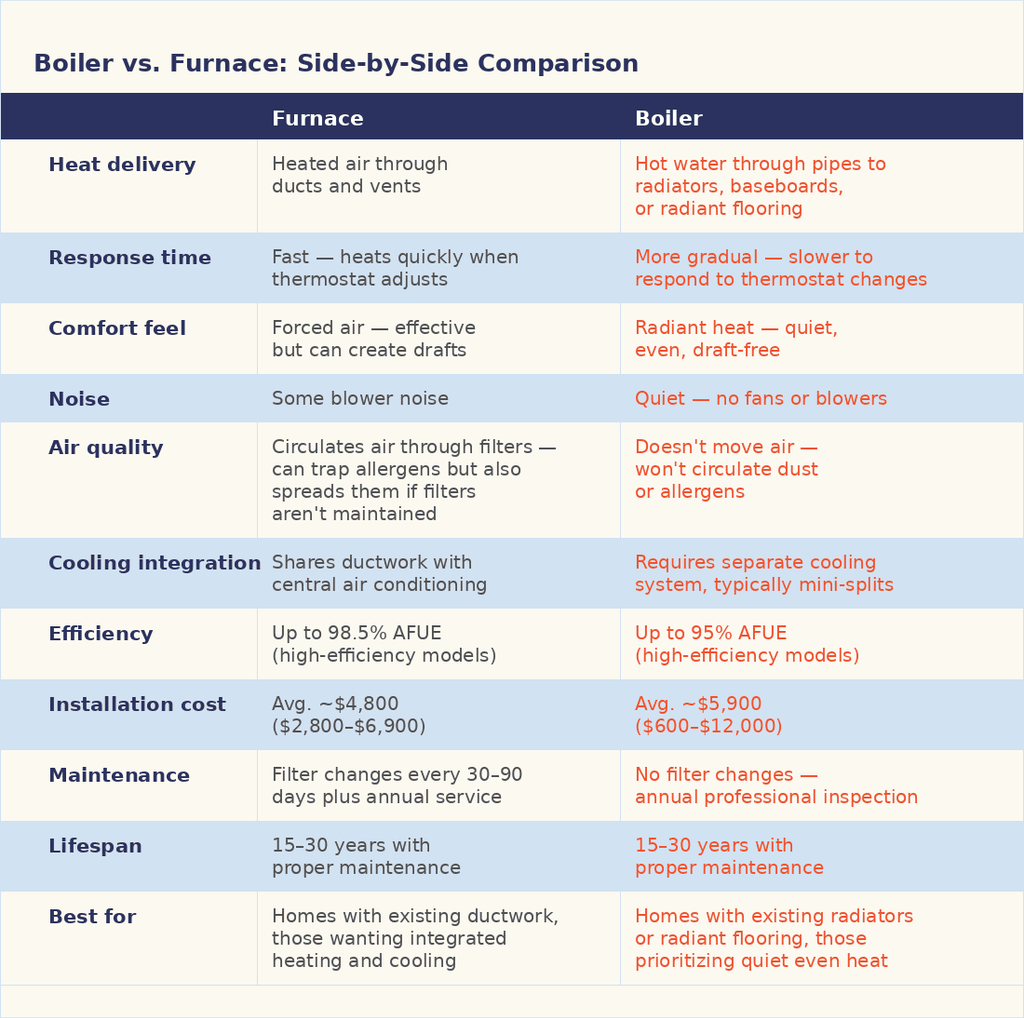
If you’ve made it through the full comparison, here’s a quick recap of the key differences in one place:
A furnace heats air and distributes it through ductwork. A boiler heats water and circulates it through pipes to radiators or radiant flooring. Both heat your home — they just do it differently.
It depends on your fuel source, local energy prices, and the efficiency of the specific equipment. High-efficiency gas furnaces edge out boilers slightly on AFUE ratings, but the bigger factor is usually the age of your current system. Replacing an old, inefficient system with either a high-efficiency boiler or furnace will produce noticeable savings.
Yes, but it’s a significant undertaking. Switching from a boiler to a furnace requires installing ductwork throughout your home. Switching from a furnace to a boiler requires running pipes and installing radiators or radiant flooring. In most cases, upgrading to a higher-efficiency version of what you already have is the more practical and cost-effective path.
Both can last 15 to 30 years. Longevity depends more on how well the system is maintained and the quality of the equipment.
Boilers don’t move air, so they don’t circulate dust or allergens. That can be an advantage for allergy sufferers. Modern furnaces with high-quality filtration can actively clean the air as they heat it, which offers a different kind of benefit.
It depends on what’s already there. Older homes in the Baltimore and D.C. area were often built with boiler systems. That’s because radiators and baseboard heaters are common in pre-1960s construction. If that infrastructure is in good shape, a boiler replacement is usually the most practical path. A licensed HVAC technician can assess your system and give you an honest recommendation.
At the end of the day, the right choice almost always comes down to what your home is already set up for. If you have ductwork, a furnace makes sense. If you have radiators or radiant flooring, stick with a boiler. If you’re building new or doing a major renovation, then consider the pros and cons in our comparison chart.
And if you’re in the Baltimore or D.C. area, Heil Plumbing & HVAC is here to help you work through it. We offer Baltimore County boiler repair and installation, Howard County boiler repair and installation, and Montgomery County boiler repair and installation. And if you’re considering a major renovation or new construction, we can give you a straight answer on which direction makes sense for your home.